Use the meter you already have.
A B2500, Venus or Jupiter only steers toward zero when it can see a power meter it recognises. AstraMeter pretends to be that meter (a Shelly Pro 3EM, CT002 or CT003) and feeds it live grid readings from your Shelly, Home Assistant, MQTT broker, smart-meter IR head, or any of 18 supported sources.
Free software, GPL-3.0. Runs as a Home Assistant add-on, in Docker, with plain Python, or on an ESP32.
How it fits in
The battery polls AstraMeter over your local network, exactly as it would poll a real meter, and gets back the current grid power. AstraMeter reads that number from whatever you already measure it with.
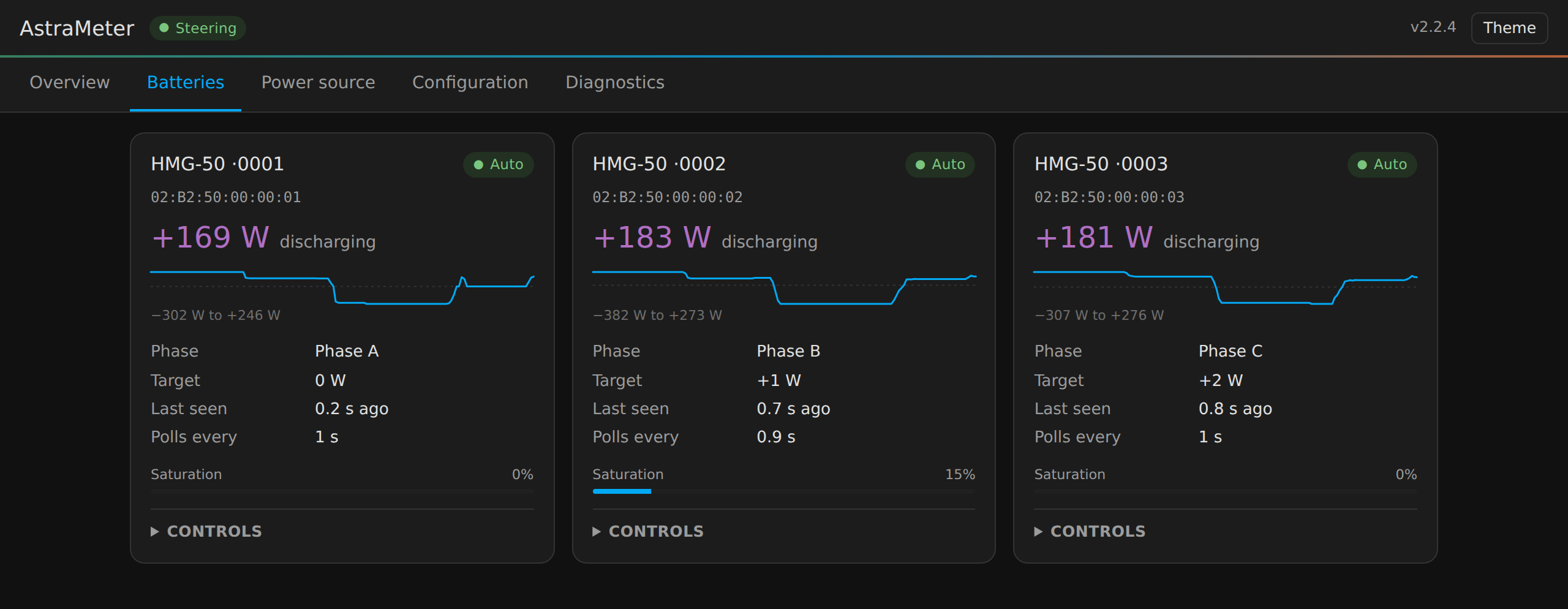
As a CT002 or CT003, AstraMeter gives each battery its own target. Every poll also reports what that battery delivered, so AstraMeter corrects the next target and the batteries share the load instead of all reacting to the same reading and overshooting.
 Emulator
Features
- Several batteries, one grid connection
- In CT002/CT003 mode the load is split evenly, or by a weight you set per battery. On small loads it can run fewer batteries so each stays above its efficient minimum, rotating them to share wear.
- 18 meter sources
- Shelly, Tasmota, Home Assistant, MQTT, Modbus TCP/UDP, SML over an IR head, HomeWizard, Enphase, SMA, Fronius, Tibber Pulse, a JSON endpoint, or your own script.
- Filtering for noisy meters
- Smoothing, a deadband and Hampel outlier rejection, plus an optional PID controller, for meters that jump around or report late.
- Three-phase
- Per-phase readings on L1, L2 and L3, each with its own offset and multiplier for calibration.
- Home Assistant entities
- MQTT Insights publishes grid power, per-battery targets and meter health through MQTT discovery, along with controls to pause a battery or set its share.
- ESP32 build
- The CT002/CT003 emulator also ships as an ESPHome component, so a small ESP32 board can do the job without a server.
Status page
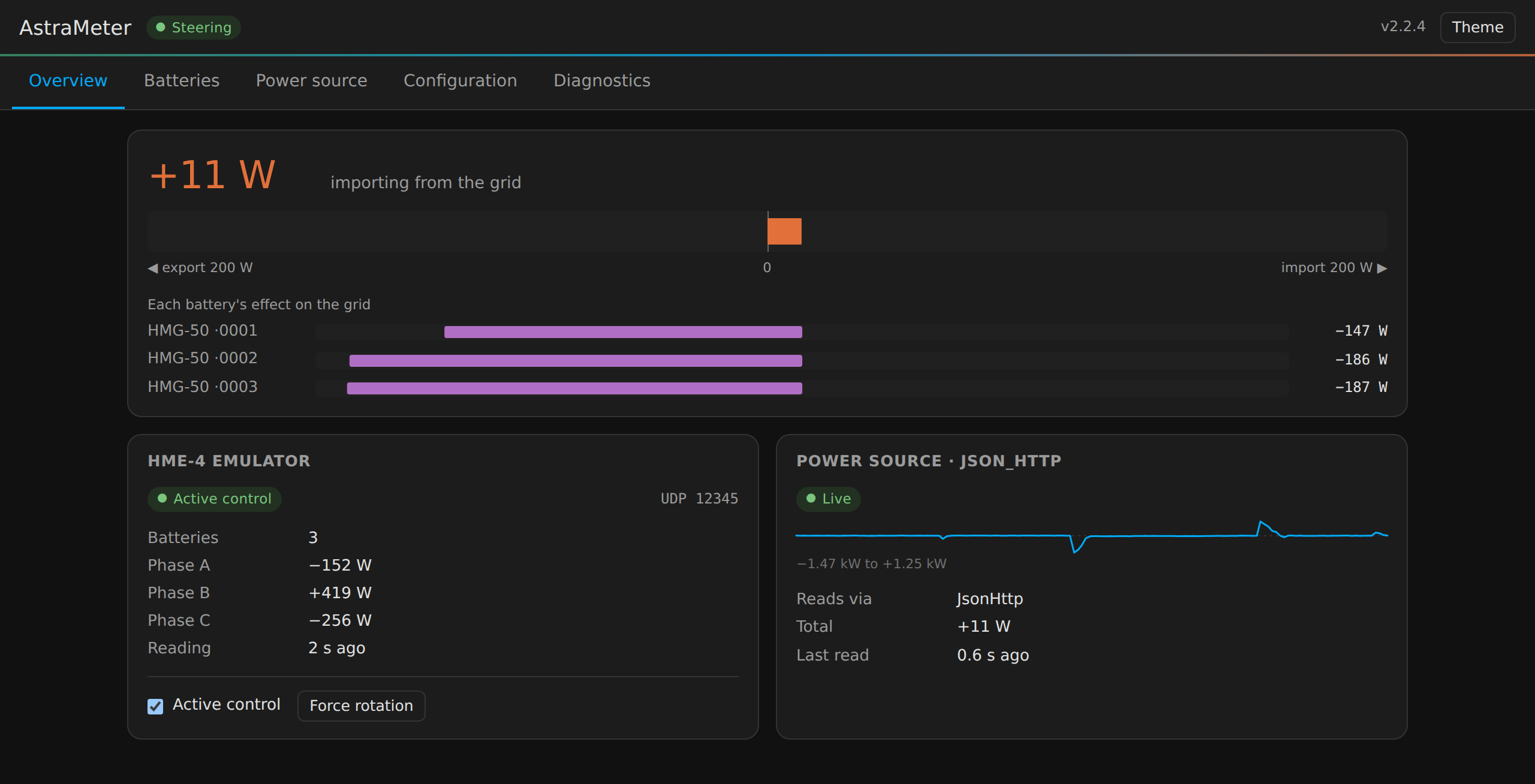
Open it from the Home Assistant sidebar, on port 52500 with Docker or Python, or at the ESP32's own address. It shows the grid reading, what each battery is being asked to do, and the health of your meter. Except on an ESP32, whose settings are compiled in, you can also edit the configuration from the browser. Dashboard docs
Compatibility
Works with the B2500, Venus, Jupiter and other Marstek storage systems that can be paired with a CT002/CT003 or Shelly meter. Once AstraMeter is running, switch the battery to Self-Adaptation mode.
| Emulated meter | Notes |
|---|---|
| Marstek CT002 (HME-4) | Recommended. Per-battery targets and load sharing |
| Marstek CT003 (HME-3) | Same as CT002 |
| Shelly Pro 3EM | Port 1010 for B2500 firmware up to v224, 2220 from v226 |
| Shelly EM Gen3 | |
| Shelly Pro EM-50 |
Install
| Method | Best for | |
|---|---|---|
| Home Assistant add-on | Home Assistant users. The easiest route. | Guide |
| Docker | A NAS or home server | Guide |
| Python | Linux, macOS or a Raspberry Pi | Guide |
| ESPHome on an ESP32 | A dedicated board, no server | Guide |
Config generator
Tell it how you'll run AstraMeter and which meter you have, and it writes the
config.ini or ESPHome YAML, explaining each option. It runs in your browser and
uploads nothing.
FAQ
Do I need to buy a specific power meter?
No. AstraMeter reads grid power from something you probably already have (a Shelly, Home Assistant, an MQTT topic, a smart-meter reader, Modbus and so on) and presents it to the battery as the meter it expects.
Should I use Shelly emulation or CT002/CT003?
CT002/CT003. Each battery reports its output back, so AstraMeter can steer it to its own target and share the load across batteries.
What's the difference between Home Assistant, Docker and ESP32?
The add-on, Docker and Python run the full emulator as software on a machine that's already on. The ESP32 build runs on a small board of its own and emulates CT002/CT003 only. The config generator writes the right file for each.
Does it cost anything?
No. AstraMeter is free software under the GPL-3.0. The config generator runs in your browser and uploads nothing.
Which Marstek batteries are supported?
B2500, Venus, Jupiter and others. If the battery can be paired with a CT002/CT003 or Shelly meter, AstraMeter can drive it.
More in the documentation and the troubleshooting FAQ.